Oct 13, 2026
How to Make TikTok Ads with Native Pacing and Hooks: 2026
Learn how to make TikTok ads with native pacing and hooks in 2026 - cut every 1-2s, hit higher hook rates, and scale market-native creatives.
TL;DR
TikTok ads live or die in the first two seconds. Native pacing means your ad moves like organic content, with cuts every one to two seconds and text at five to ten words per second. But “native” has a second layer most brands miss: what stops a scroll in one market won’t stop it in another. This guide breaks down every term you need (hook, hook rate, native pacing, pattern interrupt, creative fatigue) with benchmarks, structures, and the market-specific dimension that separates good TikTok ads from great ones.
The advice “make TikToks, not ads” gets repeated so often it’s lost its meaning. Everyone knows the principle. Few people know the mechanics. What does “native pacing” actually mean in terms of cut frequency, word count, and text speed? What separates a hook that earns two seconds from one that gets swiped past? And why does an ad that crushes it in one country fall flat in another, even after translation?
This guide answers those questions with concrete definitions, benchmark numbers, and practical frameworks. Think of it as a glossary you can actually use, one that starts with the vocabulary of TikTok ad creation and ends with a production mindset that works across markets.
If you want to see how this works in practice, Flona’s product walkthrough shows how a single product URL becomes market-specific TikTok ads with distinct hooks and pacing for each audience.
What Is a Hook in a TikTok Ad?
A hook is not an introduction. It is not your brand name, your logo reveal, or a greeting. On TikTok, the hook is the first two to three seconds of your video, and it functions as the primary retention mechanism. A viewer who doesn’t engage in that window swipes. TikTok’s algorithm reads the swipe as a negative signal and distributes the ad to fewer people.
This makes the hook the structural foundation of your ad, not a stylistic choice. Everything downstream, your click-through rate, your cost per acquisition, your return on ad spend, depends on whether the first moments earned attention.
The 3-Second Rule vs. TikTok’s Actual Measurement
You’ll hear “the first 3 seconds” everywhere. That’s useful shorthand but slightly misleading. TikTok actually measures what it calls hook rate based on two-second views, not three. The formula: two-second video views divided by total impressions. When TikTok’s own data shows that ads capturing attention in the first one to two seconds significantly outperform slow openings, they mean it literally. Your window is smaller than you think.
For context, TikTok’s attention window is one to two seconds, compared to two to three seconds on Instagram Reels, three to five on Facebook, and five on YouTube Shorts. This is the fastest platform to earn or lose a viewer.
Six Hook Categories That Work
Not all hooks are equal, but most winning TikTok hooks fall into one of these categories:
1. Pattern Interrupt. Sudden movement, an unexpected visual, something physically jarring in the first frame. A hand slapping a table. A product dropped from height. This is the fastest hook category because it triggers a reflexive pause before the viewer’s conscious brain decides to scroll.
2. Curiosity Gap. “Wait til you see what happens…” or “I can’t believe this actually worked.” The viewer stays because the payoff hasn’t been revealed.
3. Bold Claim. “This $12 product outperforms $200 alternatives.” Bold claims work because they create a tension the viewer wants to resolve, either confirming or debunking.
4. POV Setup. “POV: you just found the skincare product your dermatologist doesn’t want you to know about.” The POV format pulls the viewer into a scenario immediately.
5. Direct Address. Calling out the exact audience in the first line. One test showed that the hook “Shopify store owners, your TikTok ads probably aren’t the problem” increased the two-second view rate by 34% compared to a generic “Want more sales?” opener. It worked because it filtered for the exact audience and created instant relevance.
6. Problem-First. Leading with a frustration the viewer already feels. “Tired of ads that get clicks but no sales?” This works because recognition is faster than persuasion.
Hook Rate: The Gatekeeper Metric
Hook rate is the single metric that determines whether TikTok even distributes your ad widely enough for the rest of your creative to matter.
Formula: 2-second video views ÷ total impressions.
2026 Benchmarks
The numbers paint a clear picture of where the bar sits:
| Tier | TikTok | Meta | YouTube |
|---|---|---|---|
| Median | 33% | 28% | 22% |
| Top 10% | 55% | 45% | 38% |
Source: Benly 2026 ad creative benchmarks
Across 11 TikTok ad accounts studied by Tuff Agency, the average hook rate landed at 30.7%, while top-quartile creatives climbed to 40 to 45%.
A critical finding: UGC-style ads deliver a 41% hook rate on TikTok versus 29% for polished production. That’s a 41% advantage for content that looks like it was shot on a phone in someone’s kitchen. The ad-skip reflex fires faster on TikTok than on any other platform, and creative that reads as a traditional ad gets treated as one.
Why You Can’t Compare TikTok and Meta Hook Rates
Meta measures hook rate at three seconds, not two. A “33% hook rate on TikTok” and a “33% hook rate on Meta” represent fundamentally different achievements. The TikTok number is harder to earn because the measurement window is shorter and the audience scrolls faster. Keep your benchmarks platform-specific.
The threshold to remember: If your TikTok hook rate is below 25%, rebuild the hook. The ad isn’t getting enough distribution for any other optimization to matter.
Native Pacing: What It Actually Means
“Native pacing” means your ad’s rhythm matches how organic TikTok content moves. Not how YouTube videos move. Not how Instagram stories move. How TikTok content, specifically, feels when a viewer is mid-scroll.
The Editing Rules
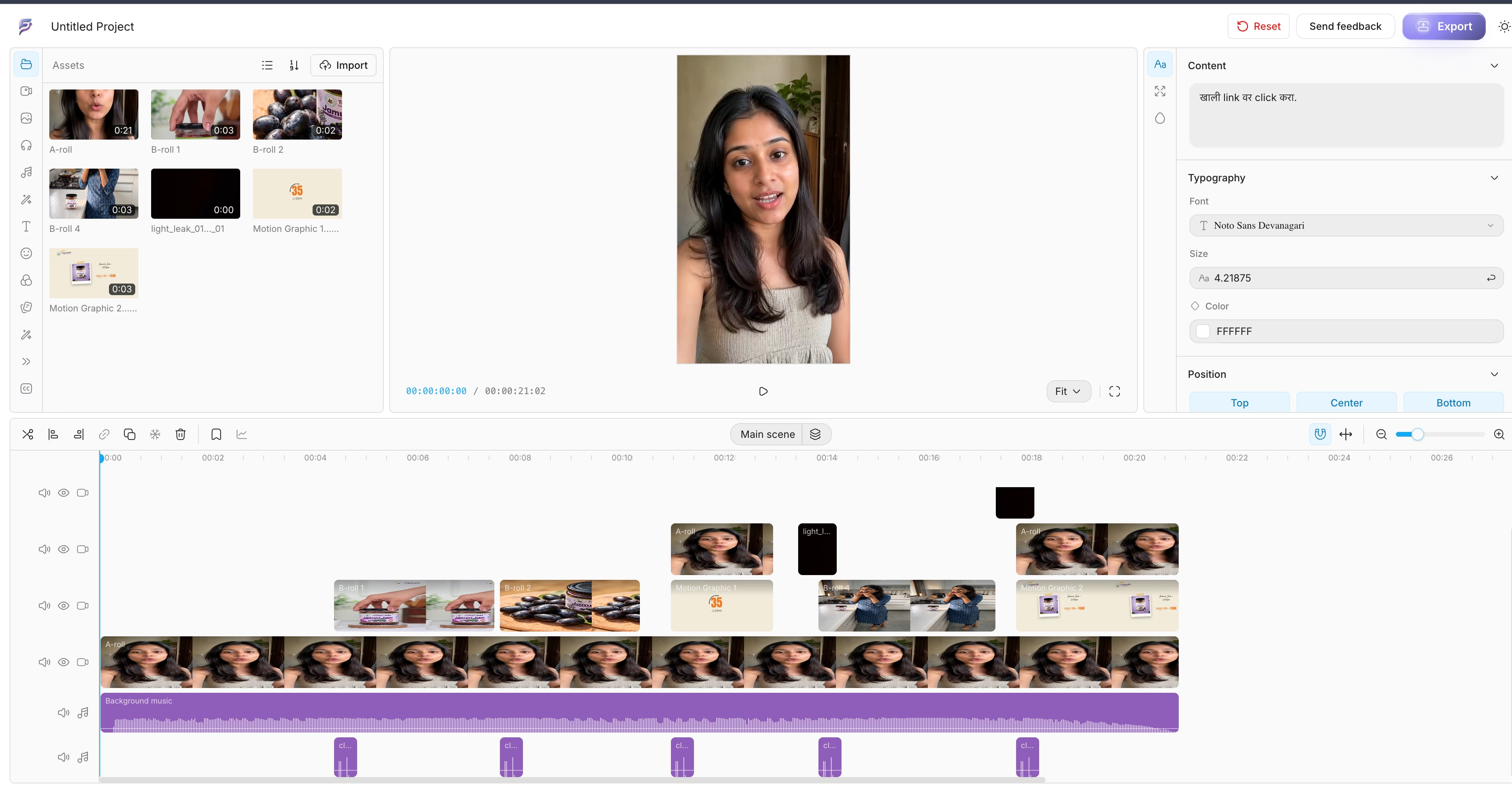
Cut frequency: Clips should change every one to two seconds. This isn’t about being chaotic. It’s about matching the visual tempo that TikTok users are trained to expect. A static shot held for five seconds feels like a loading screen to someone whose thumb is ready to swipe.
Text overlay speed: When using on-screen text, TikTok recommends displaying five to ten words per second. Slower than that and viewers get ahead of you. Faster and you lose comprehension.
Word count: A 15-second script is approximately 32 words at normal speaking pace. A high-energy TikTok presenter runs closer to 160 words per minute, which gives you roughly 40 words in 15 seconds. Either way, every word needs to earn its spot.
Why a Meta-cut ad looks foreign on TikTok: An ad built for Facebook typically uses longer shots, slower reveals, and a more deliberate build. Drop that into a TikTok feed and it sticks out immediately. The pacing signals “ad” before the viewer even registers the content. TikTok rewards native pacing, vertical framing, and on-screen text placed for TikTok’s specific UI.
The 15-Second Structure (Timestamp Breakdown)
For most TikTok ads, the sweet spot is between 9 and 15 seconds. Here’s how to allocate every second:
- Seconds 0 to 2: The hook. A visual or verbal disruption. Not a logo, not a brand name. A pattern interrupt. This is where the viewer decides to stay or leave.
- Seconds 2 to 6: The setup. The creator establishes stakes. A problem, a question, a contradiction. One line of context that makes the payoff worth waiting for.
- Seconds 6 to 11: The payoff. Product benefit, reveal, demonstration. This lands before attention decays.
- Seconds 11 to 15: The CTA or loop-back. Either a direct call to action, or a visual callback that makes the viewer want to rewatch. Rewatches signal quality to TikTok’s algorithm and extend distribution.
If you’re working from a product page and want to turn it into a short ad structure like this, adapting a product page into a short ad covers the translation from webpage to script.
Native Ad / Native Creative: The Definition
A native ad mirrors what users already consume. On TikTok, that means it looks, sounds, and moves like something a creator posted, not something a brand’s agency produced in a studio.
The Native Checklist
- Vertical 9:16 framing (fills the screen)
- Smartphone-quality footage (not cinema cameras)
- Natural lighting, handheld movement
- CapCut-style editing with quick cuts and zooms
- Trending or popular sounds
- Captions on (most users watch with sound off at least some of the time)
- Creator speaking directly to camera, not a voiceover narration
The data backs this up strongly. TikTok-first creative catches attention for 74% of viewers and drives 3.3x more action compared to repurposed content from other platforms. UGC trust rate sits at 85%.
The Ad-Skip Reflex
Practitioners on forums and in newsletters consistently make the same observation: the trained ad-skip reflex fires faster on TikTok than on Facebook or YouTube. Polished production quality doesn’t signal trustworthiness on TikTok. It signals advertisement. And advertisement signals “skip.”
This doesn’t mean production quality is irrelevant. It means the aesthetic has to match the platform. Good lighting in a bedroom is native. A ring light and a clean background are native. A studio setup with branded lower thirds is not.
For ecommerce brands that need a fast pipeline of native-looking product videos, generating Shopify product videos automatically explains how to build that volume without repeated photoshoots.
Pattern Interrupt: The Fastest Hook Type
A pattern interrupt is anything unexpected in the first frame that breaks the scroll reflex before conscious decision-making kicks in. It’s visual, audio, or motion-based, and it works because the human brain processes novelty faster than language.
Examples That Work
- A hand suddenly entering frame and grabbing a product
- Dropping something (product, glass of water, phone)
- A loud, unexpected sound (a clap, a buzzer, a record scratch)
- Jump cuts between two wildly different settings in the first second
- Text that fills the entire screen in a bold, unexpected font
- A creator mid-sentence as if the video started late (“…and that’s when I realized the $200 version was worse”)
Pattern interrupts are the fastest hook category because they bypass the two-second decision window entirely. The viewer pauses reflexively, which earns the two-second view that counts toward your hook rate.
Creative Fatigue: TikTok’s Fastest-Burning Problem
Creative fatigue happens when repeated exposure to the same ad erodes engagement. Every platform deals with it. TikTok deals with it faster than any other.
How Fast Fatigue Hits
On Meta, creative often runs for weeks, sometimes months for evergreen angles. On TikTok, three to seven days is normal, and some high-spend campaigns fatigue within 48 to 72 hours. The contributor from Influee’s blog put it in practical terms: for DTC brands spending $50 to $200 per day, refresh every two to three weeks. For $200 to $1,000 per day, refresh weekly and build a modular pipeline so fresh hooks are ready before you need them.
What TikTok Recommends
TikTok’s Ads Manager guidance says to run three to five unique creatives per ad group and three to five diversified ad groups per campaign. Fewer than three creatives in an ad group is flagged by TikTok’s system as a fatigue risk.
The volume numbers are striking: campaigns with 10 or more unique creatives achieve 1.3x higher ad recall and 3x higher purchase intent compared to campaigns with fewer than 5 creatives.
The implication is clear. You can’t produce one polished video per month and run it. You need a system that ships three to five new hook variations per week, minimum. That’s not a nice-to-have for performance. It’s the baseline for staying competitive in the algorithm.
When you’re running ads across multiple markets, this refresh problem multiplies by the number of regions you serve. Multi-language video ads without extra cost covers approaches to handling that volume.
Hook, Value, CTA: The Three-Act Structure
Every effective TikTok ad follows some version of this three-part structure. The terms change depending on who’s teaching it, but the underlying framework is consistent.
At 15 Seconds
| Act | Duration | Function |
|---|---|---|
| Hook | 0 to 2s | Stop the scroll. Pattern interrupt, curiosity gap, or direct address. |
| Value | 2 to 11s | Deliver the promise. Problem/context (2 to 6s) and product benefit or reveal (6 to 11s). |
| CTA | 11 to 15s | Tell them what to do next, or loop back to earn a rewatch. |
At 30 Seconds
The structure stretches, not duplicates. The hook stays at two seconds. The value section gets a second proof point or a testimonial beat. The CTA can be more conversational.
Why Starting With a Logo Fails
Opening with your brand name or logo is the single most common mistake in TikTok advertising. It does two things wrong simultaneously: it wastes your two-second hook window on information the viewer doesn’t care about yet, and it signals “this is an ad” to trigger the skip reflex. The brand reveal belongs at the end, or woven naturally into the value section, never at the start.
An insightful framing from the Playbook Newsletter on Substack captures this well: “You’re not testing creative. You’re testing emotional rhythm. The highest-performing DTC ads don’t win on visuals alone. They win because their tempo aligns with the customer’s inner clock.”
Market-Native Creative: The Layer Most Brands Miss
This is where the standard advice about how to make TikTok ads with native pacing and hooks falls short. Every guide tells you to match TikTok’s platform rhythm. Almost none address the fact that “native” also means native to the market your audience lives in.
What Market-Native Means
A market-native creative is an ad made for a specific market, not translated into it. The hook, the selling angle, the objections it answers, the trust signals it leads with, the person on camera, the setting, the clips, the pacing, the formality, and the format are all chosen for the audience the ad will run in front of.
This goes beyond language. Effective APAC localization requires treating each market as needing original creative developed with local audiences in mind, using translation only for supporting elements. Vietnamese audiences, for example, show strong preference for locally produced content and creators, with less receptivity to dubbed or translated foreign content compared to other Southeast Asian markets.
Why Translation Fails
Translating a winning hook into another language may lift click-through rate, but it does almost nothing for conversion rate. Language moves attention. It does not move the decision. The hook itself, its angle, its cultural reference, its trust signal, needs to be rebuilt for each market.
Country-specific creative elements produce measurable results. Ads using local holidays saw a 5 to 15% increase in installs per thousand impressions. Culturally specific visual elements improved both IPM and click-through. These aren’t marginal gains. They’re the difference between a campaign that scales and one that stalls.
Pacing Changes by Market
Pacing is not one global standard. Some markets scroll faster. Some expect more setup before a product reveal. The same script can run tight for a fast-scrolling market or slower where the audience expects more build. What stops someone in one market does not stop someone in another.
Keeping the hook and changing the language keeps the structure and loses the function. This is the core problem with the “translate your winner” approach to international TikTok advertising.
For a deeper look at this principle, scaling culturally relevant ad creatives across markets explains why market-native beats translated at every stage of the funnel.
See how Flona generates distinct ads per market, with hooks, scripts, pacing, and creator delivery tailored to each audience, from a single product URL.
TikTok Creative Codes: The Official Framework
TikTok developed its Creative Codes framework from analysis of thousands of top-performing campaigns. It’s worth knowing because it represents what TikTok’s own algorithm optimizes for.
The framework covers:
- Hook within the first second. Not the first three seconds, the first one.
- Native production style. Vertical, creator-led, platform-native editing.
- Sound on. TikTok is a sound-on platform, unlike Facebook where most viewing is silent.
- Visual variety. Scene changes and movement within short timeframes.
- Clear CTA. Specific, direct, and placed toward the end.
These aren’t suggestions. They’re the patterns TikTok identified in its best-performing ads and formalized into a repeatable playbook. Align with them and the algorithm rewards your distribution. Fight them and you’re paying for impressions that lead nowhere.
Quick-Reference Table
| Term | Definition | Key Benchmark |
|---|---|---|
| Hook | First 2 to 3 seconds of ad; primary retention mechanism | Direct-address hooks: +34% two-second view rate |
| Hook Rate | 2-second views ÷ impressions | Median 33%, Top 10% 55%, Below 25% = rebuild |
| Native Pacing | Ad rhythm matching organic TikTok content | Cuts every 1 to 2 seconds, text at 5 to 10 words/second |
| Native Ad | Ad mirroring format, framing, and tone of organic content | UGC: 41% hook rate vs. polished: 29% |
| Pattern Interrupt | Unexpected visual/audio/motion in first frame | Fastest hook category by reaction time |
| Creative Fatigue | Engagement erosion from repeated exposure | TikTok: 3 to 7 days vs. Meta: 2 to 4 weeks |
| Hook, Value, CTA | Three-act structure for TikTok ads | 2s hook, 9s value, 4s CTA at 15-second length |
| Market-Native Creative | Creative built for a specific market, not translated | Local holidays: 5 to 15% IPM lift |
| Optimal Duration | Ideal ad length for direct response | 9 to 15 seconds |
| Script Word Count | Words needed for a 15-second ad | ~32 words at normal pace |
Putting It All Together
Making TikTok ads with native pacing and hooks is not about memorizing formulas. It’s about understanding why the formulas exist. TikTok’s audience makes a stay-or-swipe decision in under two seconds. The algorithm uses that decision to determine who else sees your ad. Everything, your hook rate, your pacing, your production style, your refresh cadence, flows from that single reality.
The sequence works like this:
- Build a hook that earns the first two seconds (pattern interrupt, curiosity gap, direct address, problem-first, bold claim, or POV).
- Pace the remaining seconds to match how organic TikTok content moves (cuts every one to two seconds, text at five to ten words per second).
- Structure your ad in three acts (hook, value, CTA) with no time wasted on brand intros.
- Produce at volume. Three to five creatives per ad group is the minimum. Ten or more is where compounding performance gains start.
- Refresh faster than you think you need to. Days, not weeks.
- If you’re running in multiple markets, rebuild the hook for each one. Don’t translate. Rebuild.
That last point is where most brands hit a wall. Building market-native TikTok ads at the volume and refresh cadence the platform demands is hard enough in one language, let alone ten.
Explore Flona’s plans to see how credits and features align with different production volumes, from solo founders generating a few ads per month to agencies managing multiple brands across markets.
For teams with multi-market needs or higher volumes, contact sales to discuss enterprise workflows.
FAQ
What is a good hook rate for TikTok ads?
The median hook rate on TikTok in 2026 is 33%. Top 10% performers hit 55%. If your hook rate falls below 25%, the hook needs to be rebuilt because TikTok’s algorithm isn’t distributing the ad widely enough for other optimizations to matter.
How long should a TikTok ad be?
For most direct-response campaigns, the sweet spot is 9 to 15 seconds. This gives you enough time for a two-second hook, a value section, and a CTA without losing viewers to scroll fatigue. Longer formats (30 to 60 seconds) can work for storytelling or higher-consideration products, but they need stronger hooks to justify the length.
How often should I refresh TikTok ad creatives?
TikTok creatives fatigue in 3 to 7 days at moderate spend. For brands spending $50 to $200 per day, refresh every two to three weeks. At $200 to $1,000 per day, refresh weekly. TikTok recommends running at least three to five unique creatives per ad group to avoid triggering fatigue signals.
Is UGC really better than polished production on TikTok?
Yes, by a meaningful margin. UGC-style ads deliver a 41% hook rate on TikTok compared to 29% for polished production. Polished creative triggers the ad-skip reflex because it visually signals “advertisement” to viewers who are trained to scroll past them.
Can I translate a winning TikTok ad into another language and run it?
You can, but expect diminishing returns. Translation may lift click-through rate because the language is now accessible, but it typically does not improve conversion. The hook, selling angle, trust signals, and pacing conventions need to be rebuilt for each market, not just translated. This is the difference between a translated ad and a market-native ad.
What is a pattern interrupt in TikTok advertising?
A pattern interrupt is any unexpected visual, audio, or motion element in the first frame of your ad that breaks the viewer’s scroll reflex. Examples include sudden hand movements, product drops, loud unexpected sounds, or mid-sentence openings. It’s the fastest hook type because it triggers a reflexive pause before the viewer consciously decides whether to keep watching.
How many words should a 15-second TikTok ad script contain?
Approximately 32 words at a normal speaking pace. A high-energy presenter running at about 160 words per minute can fit closer to 40 words. Either way, every word needs to earn its place. There is no room for filler in a 15-second format.
What does “native pacing” mean for TikTok ads?
Native pacing means your ad’s visual and verbal rhythm matches how organic TikTok content moves. In practical terms: cuts every one to two seconds, on-screen text displayed at five to ten words per second, and a tempo that feels like content rather than a commercial. It also means adapting that rhythm per market, since different audiences expect different amounts of setup and different scroll speeds.